
Welcome Sign in
Product successfully added to your shopping cart
There are 0 items in your cart. There is 1 item in your cart.

Sage Dalmatian - Salvia officinalis
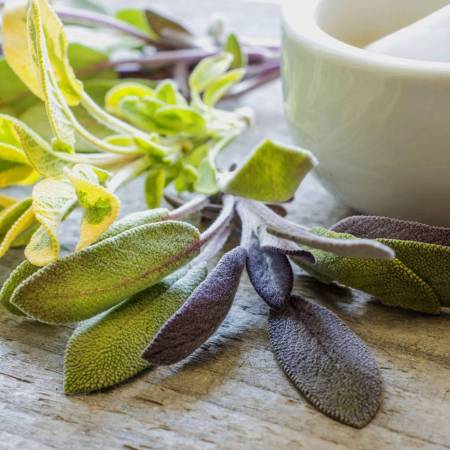
The Dalmatian sage is considered the superior Sage variety. Salvia officinalis from the Ladiatae family is also known as 'garden', 'true' and 'Dalmatian' sage. It is referred to as having a penetrating and powerful aroma.
New
Data sheet
| County of Origin | France |
| Therapeutic Properties | Anti-microbial, Anti-viral, Carminative, Digestive tonic, Emmenagogic, Estrogenic, Expectorant, Immune support, Mucolytic, Wound healing |
| Botanical Family | Lamiaceae |
| Chemical Family | Ketones |
| Approx. Shelf Life | 5 years |
| Plant Parts | Leaves |
| Note Classification | Middle | Base |
| Method of Extraction | Steam Distilled |
| Blends well with | Bergamot, Lavender, Lemon, Oregano, Rosemary. |
More info
History: The Chinese believed Sage cured sterility and the Romans believed it cured just about everything. The Latin word 'salvare' means 'heal' or 'save’. During the middle Ages, Sage was a popular ingredient of many nerve tonics and the actual herb was used to clean gums.
Characteristics: Sage Dalmatian Essential Oil has a spicy, sharp, and very herbaceous scent
Clinical Studies:
Indications: The therapeutic properties of Sage Dalmatian Essential Oil are as an anti-inflammatory, antiseptic, astringent, digestive, diuretic, emmenagogue, insecticide, laxative and as a tonic.
Personality Profile:
Subtle Aromatherapy:
Mode of Administration: Air freshener, aroma lamp, bath, diffusor, inhaler, light bulb ring, liquid candle, lotion, massage, mist spray, shampoo.
Safety: Sage Dalmatian Essential Oil is a powerful oil in the hands of an experienced aromatherapists and should be used with care. It is an oral toxin and should not be used during pregnancy, or by persons suffering from epilepsy or high blood pressure.
