Welcome Sign in
Product successfully added to your shopping cart
There are 0 items in your cart. There is 1 item in your cart.



Online only
Essential Oil Blending Basics
Blending is the creative aspect of aromatherapy and it requires a balance of practice and intuition.
It allows one to use the most appropriate essential oils in an aromatherapy treatment.
New
More info
Blending is an important aspect of aromatherapy. It allows one to use the most appropriate essential oils in an aromatherapy treatment.
Blending is the creative aspect of aromatherapy and it requires a balance of practice and intuition.
Essential oils are dynamic remedies because they are ‘synergistic’, meaning that they work together in harmony. Essential oils generally work better when mixed together with other essential oils.
When essential oils are blended, it is always worth keeping the fragrance in mind. It is more pleasing to use a remedy that has a pleasant odor for the individual concerned. Some essential oil fragrances can be quite incompatible.
Enhancing
When essential oils are blended, a certain effect, e.g. a calming, uplifting antiseptic effect, can be enhanced by blending the most suitable essential oils. This concept is referred to as a synergy. For example, bergamot may be blended with a variety of oils, each time enhancing a particular aspect of the bergamot.
Classical Blending Techniques
In the nineteenth century a Frenchman, Septimus Piesse, developed a method of classifying odors according to the notes in a musical scale. He transposed the idea of musical harmony into the realm of fragrances where the notes corresponding to each scent formed perfectly balanced chords or harmony when they were combined.
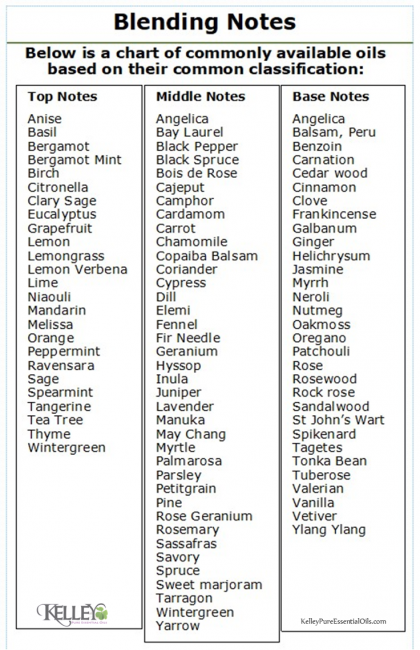
The practice of classifying essential oils and perfume ingredients into top notes, middle note and base notes still forms the basis of creating a well-balanced perfume and these principles may be applied to aromatherapy. A good perfume composition should harmoniously balance essential oils in these three categories.
A combination of orange and sandalwood, for example, can be very fresh and fruity at first, becoming more woody and balsamic later.
Balancing
Perfumers have developed analytical techniques for determining the odor intensity. The odor intensities presented below are obtained for appeal and are rated on a scale from 1 to 10. Often the odor intensity may be used as a guide to blending. The key to balance is to achieve olfactory equilibrium which occurs when two or more essential oils are in a mixture and no single essential oils dominates the odor of the blend.
For example: if making a blend of frankincense and lavender, the respective odor intensities are 7 and 5. This means that the frankincense odor is stronger than that of lavender. As a result, mixing one drop of frankincense and one drop of lavender does not produce a fragrance representing both essential oils. Frankincense would dominate. To create a blend which can be perceived as a balanced combination of both essential oils it may be necessary to mix one drop of Frankincense to 3 drops of lavender (or even more).
Blend Equalizers
Blend equalizers are those essential oils that will smooth out the sharp edges in a blend. They will balance the blend and allow it to flow harmoniously. The main purpose of the blend equalizer is to hold the blend together, but it has little effect on the blend’s distinctive personality.
Rosewood, Spanish marjoram, orange and tangerine would be blend equalizers. Fir and pine are ideal to use with cineole-rich essential oils.
Blend Modifiers
Blend modifiers will give the blend a lift and contribute to its distinctive personality. If the blend is rather flat and uninteresting, adding a drop of a modifier may improve it. They should be used sparingly as they have the ability to greatly affect the overall fragrance of the blend even when used in very small amounts.
Blend modifiers include essential oils such as clove, cinnamon, peppermint, German chamomile, cistus and vetiver
Blend Enhancers
These essential oils have pleasant fragrance and slightly modify the blend without overpowering it.
Blend enhancers include essential oils such as bergamot, cedar wood, geranium, clary sage, lavender, lemon, lime, may chang, palmarosa, sandalwood, spruce, jasmine, neroli, rose otto and myrrh.